.
.
.
 Ants interacting with aphis on a branch
PHOTO: © Daniel De Granville, 2006
.
.
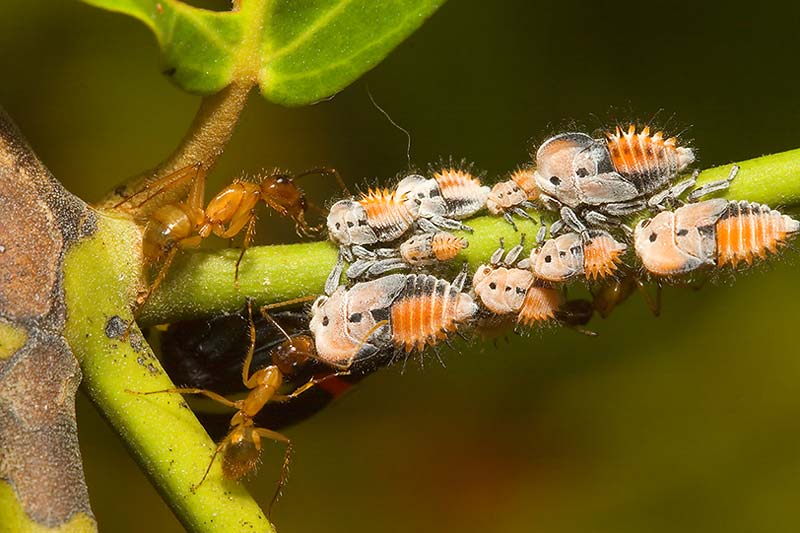 Ants interacting with aphis on a branch
 PHOTO: © Daniel De Granville, 2006
My wife Tietta found this text on a book that she read some time ago, when accomplishing her Masters’ degree. She found that it had “a lot to do with nature photography”, read it aloud to me and I decided to share it with Fotograma Bits’ readers.
Indeed, its author Edward O. Wilson (one of the world’s most outstanding living naturalists) was able to express a lot of what I feel when out in the field photographing. He talks about persistence, patience, attention, concentration, creativeness and even a bit of luck – virtually everything that I consider necessary when “hunting” for a good nature photography. I hope you enjoy your reading!
"The Right Place"
The naturalist is a civilized hunter. He goes alone into a field or woodland and closes his mind to everything but that time and place, so that life around him presses in on all the senses and small details grow in significance. He begins the scanning search for which cognition was engineered. His mind becomes unfocused, it focuses on everything, no longer directed toward any ordinary task or social pleasantry. He measures the antic darting of midges in a conical mating swarm, the slant of sunlight by which they are best seen, the precise molding of mosses and lichens on the tree trunk on which they spasmodically alight. His eye travels up the trunk to the first branch and out to a spray of twigs and leaves and back, searching for some irregularity of shape or movement of a few millimeters that might betray an animal in hiding. He listens for any sound that breaks the lengthy spells of silence. From time to time he translates his running impressions of the smell of soil and vegetation into rational thought: the ancient olfactory brain speaks to the modern cortex. The hunter-in-naturalist knows that he does not know what is going to happen. He is required, as Ortega y Gasset expressed it, to prepare an attention of a different and superior kind, “an attention that does not consist in riveting itself to the presumed but consists precisely in not presuming anything and avoiding inattentiveness”.
Edward O. Wilson, in “Biophilia, The human bond with other species” (p. 103).
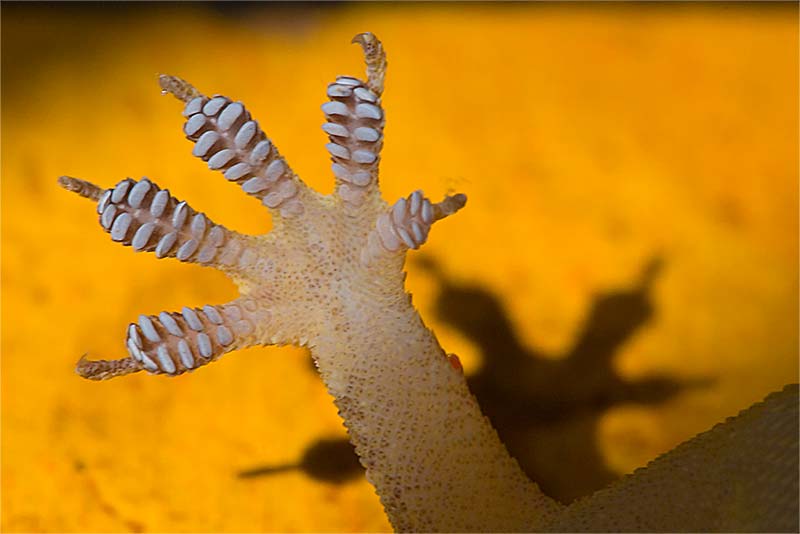 A gecko’s paw
 PHOTO: © Daniel De Granville, 2006
.
.
.