08 March, 2007

Back to School, back to São Paulo...

.
.
.
Opening page of my story on the Pantanal
published at Toyota Magazin (Germany)
PHOTO © Daniel De Granville, 2006


In recent times, my work has naturally followed a path closely associated with communications – particularly talking about environmentally-related scientific subjects – be it in my duties as a photographer, biologist or naturalist guide.

Some good examples are the photos and articles that I published in Magazines such as Atualidades Ornitológicas (Brazil), Toyota Magazin (Germany) and at National Geographic’s website, the scientific publications about birds and conservation of private reserves in which I participated as an author, the Bonito Field Guide and the field works with elementary and undergrad students from Brazil and the USA.

For such reasons, lately I was thinking of undertaking some studies on the journalistic field. Hence I applied and got approved for a postgrad course on Scientific Journalism at Unicamp, one of Brazil’s major public universities. The course lasts for one and a half years, a period during which I will have to move from Bonito and the Pantanal to the region of Campinas (São Paulo State).

Stay tuned for more info about this sudden and very positive change – coming soon!


Cabeceira do Prata Private Reserve (Jardim, MS, Brazil)
Photo published at Horizonte Geográfico Magazine (Brazil)
PHOTO © Daniel De Granville, 2005

.
.
.

25 February, 2007

Tales from Germany, Part 2: Dogs

.
.
.
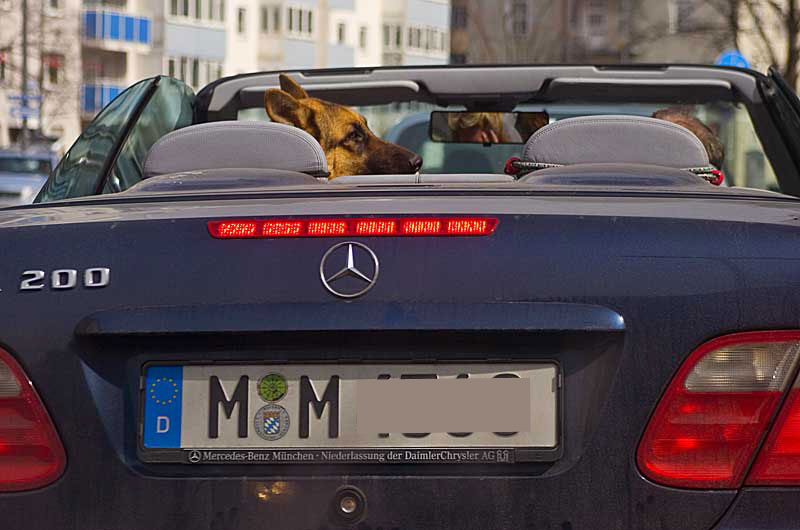
"Oh Lord, won't you buy me a Mercedes-Benz?"
PHOTO: © Daniel De Granville, 2006


Following on with the “Tales From Germany” series, today I’ll tell you some great stories about dogs and how influential they are in Munich’s society. Some local folks even told me that there are several scientific studies analyzing this close relation between humans and canids in Munich, and the main character of another highlight photo (the opening image of this post) from my exhibit in Germany is a… GERMAN Shepherd .

At least in that city, dogs have free access to shops and restaurants, get to ride in subway trains (but they’ve gotta pay for the ticket!), swim in the parks' lakes with the owner and ride convertible Mercedes-Benz... At the entrance of every urban park there are some dispensers from which dog owners must pick up a disposable bag with a built-in “poop scoop” and step-by-step instructions on how to collect the doggie’s excrements.

My firsthand experience with the subject was kind of hilarious. Every morning I’d go out before sunrise to photograph in a nearby natural area, Park Feldafing, almost always under below-freezing temperatures. One of these days I was shooting tree shadows with snow knee-high when I noticed an elderly lady shouting at her dog who had something in its mouth: "AUS! AUS! AUS!", she'd yell. In Brazil, "AU! AU!" is how dogs bark (like "WOOF! WOOF!" in English), but no, she was not trying to communicate directly with her four-legged buddy. The furball had just picked up something it wasn’t supposed to, and she was saying in proper German that he should put it out. So that was my first practice of "Learning German, Lesson 1": "AUS" = "OUT"...


Shooting snow landscapes and learning German
at Park Feldafing!
PHOTO: © Daniel De Granville, 2006


*FYI: In German, dogs bark "wau wau" or "wuff wuff"
...

.
.
.

21 February, 2007

Tales From Germany, Part I:
"München Mag Dich"

.
.
.
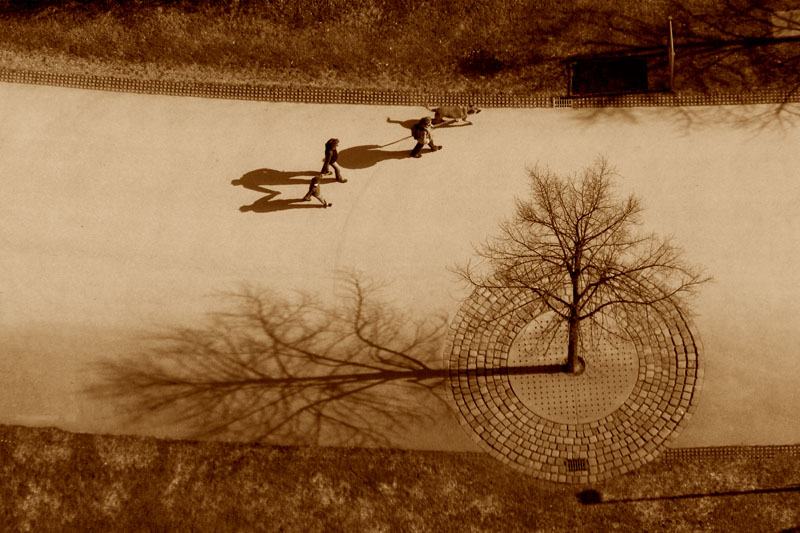
“München Mag Dich”
PHOTO: © Daniel De Granville, 2006


As some of you know, last year I spent three months in Germany photographing and exhibiting my work by invitation of Munich’s Department of Culture. Since in a few days I will be celebrating the first anniversary of this event, the next posts of FotogramaBits will tell some behind the scenes stories about my adventures in Bavaria and the Villa Waldberta.

Among the 28 photos that made it to the final selection, the picture above was one of the most appreciated by visitors of my exhibition. Therefore, I found it interesting to tell details about how this image was accomplished, showing how persistent and creative a photographer must be when searching for a good photo situation.

At first I was determined to photograph a tree from above, in the early morning or late afternoon, with its shadow projecting on snow. I almost drove people crazy trying to get what I needed in order to achieve my goal: A helicopter? A hot air balloon? A crane? A church tower in the middle of nowhere? A flock of birds feeding under the tree, with its shadows also projecting on the ground? Or maybe some typical Bavarians herding cattle under the shade? Time was short, there were many uncertainties and costs involved, so that I ended up quitting on the original idea.

Some time later I was shooting in town with Juliana, a long-time friend who helped me as an assistant during some assignments. In the middle of the afternoon she wasn’t feeling so well, and didn’t want to join me on the last visit that we had planned for that day, to Olympiapark (where the 1972 Olympic Games were held). I was also about to give up, since I was pretty tired too and didn’t believe that any interesting shot could come from there, but ended up going on my own. I paid 4 Euros to get up on the tower that provides a panoramic view of Munich and the Alps, and was very surprised to get – almost entirely by chance – an image very similar to the one I wanted, of a tree seen from above. It was a very complicated shot, since there was a glass protection and its concrete frame sticking out right underneath, so I had to stand on my toe tips and stretch my neck in order to get a proper shooting position.

Besides the visual beauty, this photo was successful for showing a couple holding hands and forming the letter “M” as in “Munich” (the city’s motto for the 2006 Soccer World Cup was MÜNCHEN MAG DICH – “Munich Loves You”)…


.
.
.